
Benchmark indices Sensex and Nifty gave up early gains to close lower for a fourth straight session on Thursday due to selling in IT and banking shares amid weak global equities. The 30-share BSE benchmark settled 98 points or 0.18 per cent lower at 53,416.15. During the day, it hit a high of 53,861.28 and a low of 53,163.77. The broader NSE Nifty also pared initial gains and ended 28 points or 0.18 per cent down to settle at 15,938.65.

Benchmark indices continued their downtrend for the fifth session on the trot on Thursday, with the Sensex tumbling nearly 817 points in early trade, tracking weak global trends and selling in index majors Reliance Industries and HDFC Bank. Unabated selling by foreign institutional investors also weighed on the sentiment. The 30-share BSE Sensex was trading 816.78 points lower at 53,271.61. The NSE Nifty declined 234.05 points to 15,933.05.

Technology stocks rallied, with the IT index up 2.45 per cent as TCS, Infosys, Wipro and HCL Technologies spurted following favourable rupee movement.

Equity benchmarks Sensex and Nifty on Thursday gave up all early gains to settle lower as surging oil prices amid the ongoing conflict between Russia and Ukraine hit investor sentiment. The 30-share BSE Sensex started the trade on a higher note and jumped 527.72 points in morning deals to a high of 55,996.62. However, during the afternoon trade it surrendered all its early gains and finished at 55,102.68, lower by 366.22 points or 0.66 per cent.

The domestic benchmark indices - the S&P BSE Sensex and the National Stock Exchange Nifty50 - had lost close to 1.5 per cent in three days recently before gaining slightly. Notwithstanding weakness and volatility, the Nifty50 has managed to hold on to the 18,000 mark, while the Sensex has managed to stay above the 61,000 level. The performance of the stocks that comprise these front-line indices remains polarised.

Equity benchmarks shrugged off lacklustre global cues to clock smart gains on Tuesday, buoyed by strong buying interest in index heavyweights Reliance Industries and HDFC twins. However, a depreciating rupee and unabated foreign fund outflows capped the gains, traders said. The 30-share BSE Sensex rallied 562.75 points or 0.94 per cent to settle at 60,655.72.

The data was not available for a couple of days and it created panic in the public, mostly among the people excluded from the list as the rejection certificates were yet to be issued.

Indian IT companies like Tata Consultancy Services, Infosys, HCL Technologies and others have taken the buyback route to return some wealth to their shareholders, while potentially boosting their stock prices.

Equity investors became poorer by over Rs 6.71 lakh crore on Thursday as domestic benchmark indices tumbled amid a global market meltdown. The 30-share BSE benchmark Sensex tanked 1,416.30 points or 2.61 per cent to settle at 52,792.23, tracking weak global markets and persistent foreign fund outflows. In line with the weak market trend, the market capitalisation of BSE-listed firms tumbled by Rs 6,71,051.73 crore to stand at Rs 2,49,06,394.08 crore.

In a major relief to Indian information technology (IT) companies operating in Australia, Canberra has agreed to amend its domestic laws to stop taxing offshore income of such Indian companies, as part of the free trade deal inked. This may lead to savings up to $200 million each year for over 100 Indian IT companies operating in Australia. "The Government of Australia has agreed to amend the domestic taxation law to stop the taxation of offshore income of Indian firms providing technical services to Australia. "This will resolve the issue that the Indian government has raised about the double taxation avoidance agreement (DTAA) between the two governments for the avoidance of double taxation and the prevention of fiscal evasion with respect to taxes on income," said a commerce ministry official.

Despite the wobble in the markets over the past few weeks, Indian equities remain expensive as measured by several yardsticks. India's market capitalisation-to-GDP ratio, for instance, has touched a multi-year high. The ratio is currently at 116 per cent, based on the FY22E gross domestic product (GDP) number, above its long-term average of 79 per cent.

Infosys, TCS, and Wipro still rake in profits, but they face challenges ranging from a stronger rupee to the likes of IBM and Accenture romping on their home turf.

Benchmark indices started the trade on a weak note on Wednesday with the Sensex falling 564.77 points, following feeble global market trends and persistent foreign capital outflows. The 30-share BSE Sensex was trading 564.77 points lower at 52,612.68. The NSE Nifty dipped 162.4 points to 15,687.80. Among the Sensex pack, IndusInd Bank, Hindustan Unilever, Bajaj Finserv, Titan, Kotak Mahindra Bank and Bajaj Finance were the major laggards in early trade.

Krithi Krithivasan is the kind of person one might look to when the need is to calm things down and put things back on track.

Despite Covid downturn, CEO salaries went up by an average of 19% in FY21.
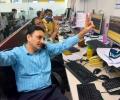
Equity investors became richer by over Rs 5.77 lakh crore on Tuesday, helped by a rally in the broader market where the BSE benchmark jumped nearly 2 per cent. The BSE Sensex zoomed 934.23 points or 1.81 per cent to settle at 52,532.07. Driven by the rally in equities, the market capitalisation of BSE-listed firms jumped by Rs 5,77,006.83 crore to stand at Rs 2,40,63,930.50 crore. "Absence of fresh selling triggers in the domestic and global economy along with falling commodity prices relieved the heavily discounted equity market to showcase recovery.

'We will continue to refine our operating model to drive more simplicity and nimbleness.'

As many as 15 companies, including Adani Copper Tubes, LG Electronics and Wipro Enterprises, with committed investment of Rs 1,368 crore, have been selected as beneficiaries under the PLI scheme for the white goods sector, the government said on Tuesday. In March, the commerce and industry ministry had reopened the application window for its Rs 6,238-crore PLI scheme for white goods -- air-conditioners (ACs) and LED lights-- with an aim to accommodate more players as several firms had expressed interest in the initiative. Last year, as many as 46 firms, including Daikin, Panasonic, Syska and Havells, with committed investment of Rs 5,264 crore were selected in the first round the scheme.

'We are on a whole different level of complexities and fundamental change is happening in the industry. There is a need for organisations to design themselves to deal with such complexities.'

The combined weight of IT companies in the benchmark Nifty 50 index is now at a five-year high of 15 per cent as these companies continue to outperform the broader market.

By 2026, around 25 per cent of the global population may spend at least an hour a day on Metaverse. This will open the doors for many businesses, the NFTs market will spread, and Web 3.0 will attract more investment.

This is expected to benefit subcontractor firms such as Manpower Group, Randstad, Adecco, Kelly Services, Allegis Global Solutions and a host of other boutique staffing firms which supply skilled manpower to technology companies in the US.
The BSE Sensex maintained its winning run for the fourth session on the trot on Wednesday to reclaim the 60,000-level after a gap of over four months as investors remained upbeat amid softening crude oil prices and persistent foreign fund inflows. A strengthening rupee and positive Asian markets further bolstered sentiment, traders said. The 30-share BSE benchmark jumped 417.92 points or 0.70 per cent to settle at 60,260.13 -- closing above the psychologically key 60,000-mark for the first time since April 5 this year.

By the end of the June quarter, the top four - TCS, Infosys, Wipro and HCL Tech employed 10,15,000 employees - down by 9,144 employees over the previous quarter.
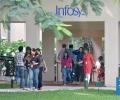
Infosys has shot off a missive to its employees, asserting that dual employment or 'moonlighting' is not permitted, and has warned that any violation of contract clauses will trigger disciplinary action "which could even lead to termination of employment". "No two timing - no moonlighting!" India's second largest IT services company said in a strong and firm message to employees on Monday. Put simply, moonlighting refers to employees taking up side gigs to work on more than one job at a time.
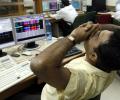
Equity indices chalked up losses for the second straight session on Monday, in tandem with a bearish trend overseas as ratcheting up of hostilities in Ukraine and prospects of further rate hikes by the US Fed soured global risk sentiment. The rupee slipping to another all-time low against the US dollar amid foreign fund outflows added to the gloom, traders said. After tumbling over 800 points in intra-day trade, the 30-share BSE Sensex clawed back some lost ground to end 200.18 points or 0.34 per cent lower at 57,991.11.

Most of the large Indian IT services players, such as TCS, Infosys, Wipro, and HCL Tech, have signalled increased offshoring efforts and opting for local hires in the US, primarily to address the immigration-related challenges.
The controversy over visas for high-skilled workers from abroad is about to get hotter. H-1B visa program was set up to allow firms in US to import the best in technology, engineering, and other fields when such workers are in short supply in America. But data released by the federal government show that offshore outsourcing firms, particularly from India, dominate the list of companies awarded H-1B visas in 2007.

In one of the biggest donations by a business family in India, the family of Adani Group chairman Gautam Adani on Thursday committed to donating Rs 60,000 crore (around $7.7 billion) to various charities related to health care, education, and skill development. The commitment has been made to mark Gautam Adani's 60th birthday on Friday as well as the birth centenary year of his father Shantilal Adani. The corpus will be administered by the Adani Foundation. "At a very fundamental level, [programmes] related to all these three areas should be seen holistically and they collectively form the drivers to build an equitable and future-ready India.

Sector experts say rising pressure on margins owing to price discounts on the core business, increased hiring in the US and emergence of new technology areas are key reasons for such cost cutting.
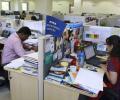
Software major Tata Consultancy Services on Wednesday reported a 14.8 per cent rise in net income to Rs 11,392 crore for the fourth quarter of last fiscal against Rs 9,959 crore in the year-ago period. The country's largest technology services company by market value said its revenue rose 16.9 per cent to Rs 59,162 crore during the reporting season from Rs 50,591 crore a year ago.

The Adani group has the maximum number of companies in the trillion club at five, followed by the Tata group (four).

In the last couple of months, top Indian IT services providers, including TCS, Infosys, Wipro and HCL Tech have announced setting up cyber threat management centres in the US and Europe.

Pricing pressure in traditional technology services and slow growth in emerging technologies may turn out to be the spoiler for Indian infotech companies, says Ayan Pramanik.

To begin with, there would be the immediate integration of various technology stacks. This would create more business for global consulting and IT services entities such as KPMG, PwC, EY, Accenture and IBM, among others. Indian service providers - Infosys, Tata Consultancy Services (TCS), and Wipro, for instance - would also cash in.

A slowdown in hiring by India's top IT companies has resulted in a sharp increase in the industry's profit per employee in Q3FY23. The top four IT companies earned a net profit of 1.7 lakh per employee during October-December 2022, up 8.6 per cent from Rs 1.57 lakh in Q2FY23 and 16.3 per cent from a record low of Rs 1.47 lakh in Q1FY23. Earnings per employee in the third quarter were, however, still down 0.9 per cent on a year-on-year (YoY) basis.
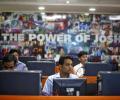
The reduction in hiring indicates a shift in the business model from hiring thousands of people to write code cheap to using artificial intelligence for repeatable tasks.

Benchmark stock indices Sensex and Nifty tumbled nearly 1 per cent on Wednesday due to profit booking in banking, financial and IT stocks after a recent rally. The 30-share BSE Sensex plunged 537.22 points or 0.94 per cent to end at 56,819.39 as 24 of its stocks declined. During the day, it tanked 772.57 points or 1.34 per cent to touch a low of 56,584.04. The broader NSE Nifty declined by 162.40 points or 0.94 per cent to 17,038.40 with 39 of its constituents ending in the red. Bajaj Finance was the biggest loser among Sensex stocks, dropping by 7.24 per cent.
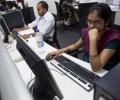
Investors are already factoring in the impact. The IT Index on the BSE exchange dipped 2.5 per cent, with Infosys, Wipro and TCS showing a decline.
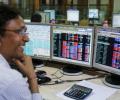
Equity benchmark Sensex pared its early losses to close higher by 231 points on Monday, helped by buying in index heavyweight Reliance Industries and ICICI Bank amid positive global trends. After falling 537.11 points to a low of 56,825.09 in morning trade, the 30-share BSE barometer staged a recovery in afternoon trade and climbed 231.29 points or 0.40 per cent to settle at 57,593.49. As many as 20 Sensex stocks closed with gains while 10 declined. The broader NSE Nifty recovered 69 points or 0.40 per cent to settle at 17,222 with 29 of its constituents ending in green.
